
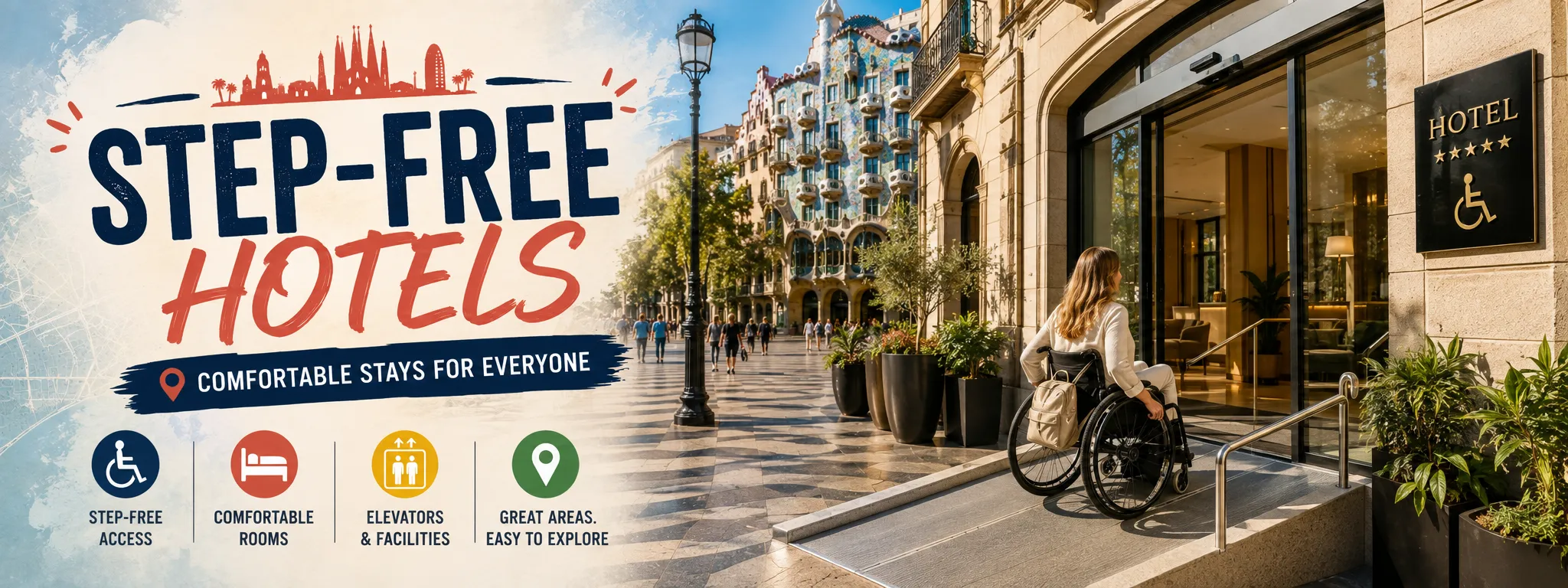
Define what “step-free” means for you
A hotel can advertise accessibility while still having a threshold at the entrance, steps to breakfast, a small lift or an accessible room that differs from the one shown in your booking. Start with your own non-negotiables: no steps at all, maximum threshold height, lift dimensions, roll-in shower, grab rails, transfer space, shower seat, bed height, hoist clearance or a room close to the lift.
Ask the property to confirm those points for the exact room category you will book. A general statement that “the hotel is accessible” is not enough when a failed assumption would make the stay unworkable.
Verify the whole street-to-room route
- Is there a step or steep ramp between pavement and reception?
- Can the main door be opened independently, or is assistance required?
- Does the lift reach the booked floor without an intermediate stair?
- Are corridors and room doors wide enough for your mobility device?
- Is breakfast, the restaurant and any facility you plan to use on a step-free route?
- Is there an accessible emergency or evacuation procedure appropriate to your needs?
Ask for bathroom details, not a label
Bathrooms are where vague listings cause the most trouble. Confirm whether the shower is truly level-entry, whether there is a fixed lip, where grab rails are positioned, whether a shower seat is fixed or portable, and how much transfer space exists beside the toilet. If measurements matter, ask for measurements or current photographs of the actual accessible room type.
Neighbourhoods that usually reduce friction
Eixample is often the easiest first choice because of its broad pavements, grid layout, frequent crossings and large hotel supply. Poblenou can suit travellers wanting flatter streets and beach access with a more modern building stock. Sants and Les Corts can be practical for transport and less complicated street layouts.
The Gothic Quarter and parts of El Born are atmospheric but demand closer inspection: medieval lanes, old building entrances, loading restrictions and uneven or narrow routes can add friction even when the hotel room itself is suitable. Gràcia varies block by block and rises toward the hills. Choose the exact street, not just the district name.
Use accessible transport data, not assumptions
TMB says lifts are installed at most Barcelona metro stations — currently 156 of 165 — and provides information on stations that are not accessible plus lift status. That is excellent coverage, but it is not the same as every station and interchange being step-free in every direction. Plan the specific origin, destination and interchange, and check lift status close to travel time.
TMB’s journey-planning information can help identify accessible routes, while its own tools warn that theoretical accessibility may not reflect real-time lift conditions. Build a bus or taxi alternative into important journeys such as airport departures or timed attractions.
Buses can be an important backup
TMB reports that its bus network has been adapted for people with reduced mobility, including ramps and kneeling systems. Buses can therefore be useful when a metro lift is unavailable or when the nearest accessible metro route involves a long detour. Traffic makes journey times less predictable, so allow margin for timed bookings.
Airport and taxi arrival planning
Tell the hotel how you plan to arrive and ask where an accessible taxi can stop. In the Old Town, the nearest practical drop-off may not be directly at the entrance. If you use a wheelchair-accessible taxi or transfer, book the correct vehicle type rather than assuming any taxi can accommodate your chair or scooter.
Check every facility you care about
A step-free room does not automatically mean a step-free rooftop, pool, spa or breakfast terrace. Ask separately about each facility. Pool access is particularly variable: a level pool deck does not mean there is a hoist or suitable entry into the water. Historic buildings may have protected spaces that cannot be reached by the guest lift.
Get critical details in writing
Once a property confirms the required features, keep the reply with your reservation and make sure the accessible room type is explicitly attached to the booking. Reconfirm shortly before travel if the feature is essential. If you book through a third party, contact the hotel directly as well; a request entered in a booking-platform comment box is not the same as the hotel confirming it.
Have a failure plan
Even a well-planned accessible trip can encounter a lift outage, maintenance closure or room-allocation mistake. Save the hotel’s direct contact details, identify an alternative accessible transport route, and avoid scheduling your first critical activity immediately after arrival. A small buffer turns a disruption into an inconvenience rather than a trip-breaking problem.
Copy-and-send hotel checklist
- Is the route from pavement to my exact room step-free?
- What are the entrance, lift and room-door widths?
- Does the bathroom have a level-entry shower and the grab rails I need?
- What transfer space is beside the toilet and bed?
- Can I reach breakfast and the facilities I plan to use without steps?
- Can you guarantee this accessible room category on my reservation?
- Where can an accessible taxi stop, and can staff assist if needed?